Observability-Driven Sensor Placement and Delay-Resilient Kalman Filtering for Traffic State Estimation on Ring Roads
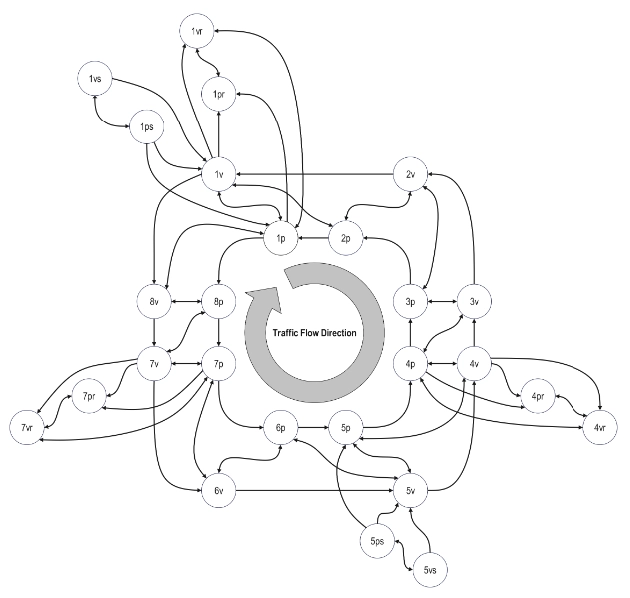 Image credit: Kevin Riehl
Abstract
Accurate traffic state estimation on large-scale ring-road motorways is challenged by sparse sensing and delayed or out-of-sequence measurements. This paper presents a framework based on the macroscopic traffic-flow model METANET that combines graph-theoretic sensor-placement rules for strong structural observability with nonlinear Kalman filtering, including the Extended Kalman Filter (EKF), Unscented Kalman Filter (UKF), Modified Re-iterated Kalman Filter (MRIKF), and Modified Re-iterated Unscented Kalman Filter (MRIUKF). The proposed placement yields an observability-sufficient sparse sensor layout under the adopted ring-road graph structure, while the re-iterated filters process delayed measurements by updating historical states and propagating the correction forward. Synthetic tests and a calibrated Simulation of Urban MObility (SUMO) case study of Amsterdam’s A10 Ring Road show that the sensor layout reduces sensing requirements by over 40%. Under stress-test delays, MRIKF reduces density mean absolute error (MAE) by up to 86.17% relative to EKF and 5.58% relative to the delay-aware Bar-Shalom out-of-sequence measurement (BS-OOSM) baseline, demonstrating a sensor-efficient and delay-resilient framework for real-time motorway traffic state estimation.

Kevin Riehl
Doctoral Researcher & Scientist
My name is Kevin Riehl, and I am a cosmopolitan, technology enthusiast and philantrop. I believe, that technology is the key to make the world a better place, and that learning, self-improvement, collaboration and criticial thinking are our duty as gifted minds.