EQ-ALINEA – Equitable Ramp Metering For Sustainable Metropolitan Highways
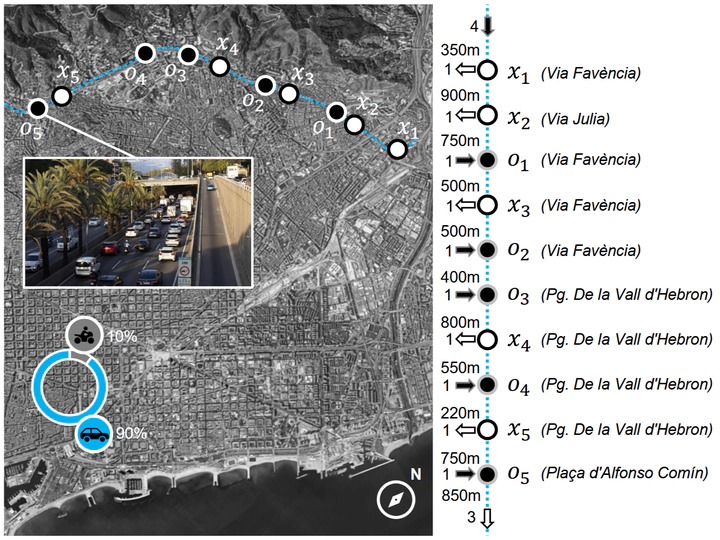 Image credit: Kevin Riehl
Abstract
Highway congestion leads to urban traffic diversion, increased emissions, and extended travel times. Even though ramp metering systems effectively reduce congestion, they often do face public opposition and lack acceptance due to inequitable delay distribution and ramp access among users. EQ-ALINEA, an extension to the ALINEA algorithm, balances both the fairness and efficiency aspects of ramp metering. EQ-ALINEA implements Utilitarian (total travel time), Rawlsian (maximum waiting times at on-ramps), and Egalitarian (dispersion of delays) fairness. Three boundary conditions prevent queue spill-backs, unacceptably long maximum waiting times, and ensure sufficient time for ramp dequeueing. A microsimulation-based case study on Barcelona’s metropolitan highway ring-road Ronda de Dalt showcases how EQ-ALINEA can effectively improve efficiency and fairness of highway traffic. The results show that more equitable transportation does not have to come at the cost of losses in efficiency or environmental impact. Besides democratizing the delay distribution over the user population (50% smaller Gini-coefficient) and significantly reducing maximum waiting times (by 40%), EQ-ALINEA redistributes highway accessibility to create more equal opportunities for all ramp users. Ultimately, the contribution of this work is to gain public acceptance for ramp metering by integrating fairness into the traffic control strategy. Code & Resources https://github.com/DerKevinRiehl/eq_alinea_control

Kevin Riehl
Doctoral Researcher & Scientist
My name is Kevin Riehl, and I am a cosmopolitan, technology enthusiast and philantrop. I believe, that technology is the key to make the world a better place, and that learning, self-improvement, collaboration and criticial thinking are our duty as gifted minds.