Multi-Agent Reinforcement Learning of Karma Bidding Strategies
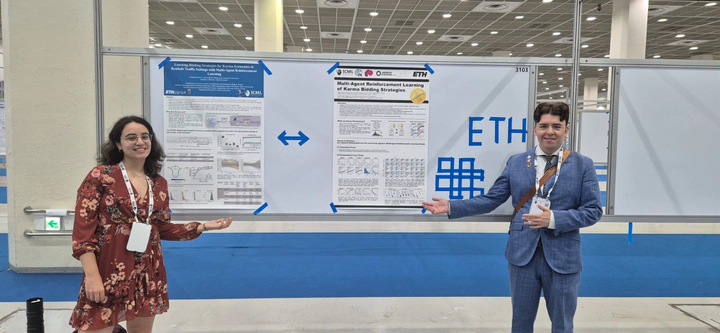 Image credit: Kevin Riehl
43rd International Conference on Machine Learning (ICML 2026), New Frontiers in Game-Theoretic Learning Workshop, Seoul, South Korea, July 11, 2026.
Capacity-constrained shared infrastructure systems require demand management mechanisms that balance efficiency and fairness. Karma mechanisms address this challenge using an artificial, non-tradable currency that enables decentralized allocation through repeated bidding, but computing equilibrium strategies in such settings is difficult due to unknown population dynamics, stochastic demand, and computation time in practice. Here, we study suitable regimes to prove convergence towards stochastic Nash equilibria when following a multi-agent reinforcement learning approach. Computational case studies demonstrate empirically that learned policies closely approximate equilibrium behavior, and further assess impact of learning algorithm and policy initialization on convergence speed. The work highlights the practical potential of the approach for real-world decision support in repeated access-allocation settings.
ICML conference page · Paper on OpenReview · Source code on GitHub
 |  |  |  |
 |  |  |  |
 |  |

Kevin Riehl
Doctoral Researcher & Scientist
My name is Kevin Riehl, and I am a cosmopolitan, technology enthusiast and philantrop. I believe, that technology is the key to make the world a better place, and that learning, self-improvement, collaboration and criticial thinking are our duty as gifted minds.