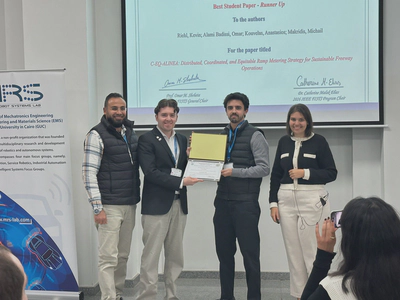
C-EQ-ALINEA: Distributed, Coordinated, and Equitable Ramp Metering Strategy for Sustainable Freeway Operations
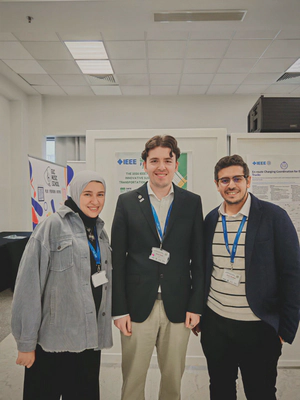
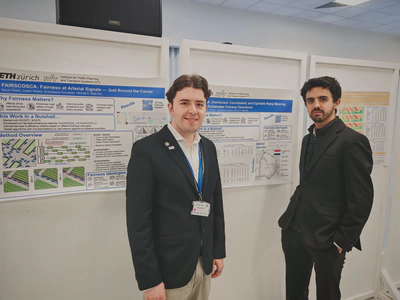
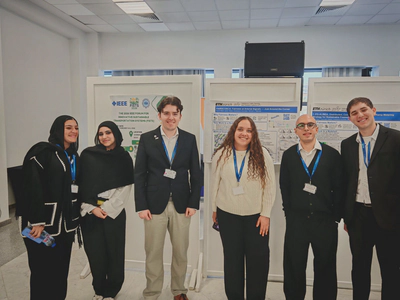
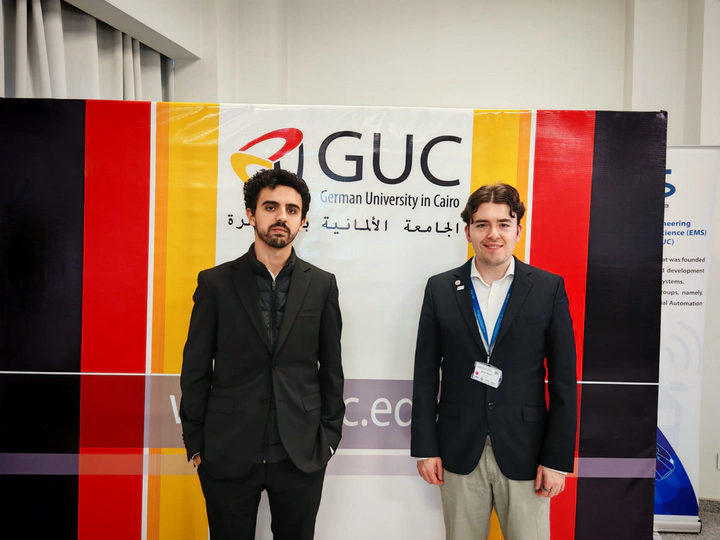 Image credit: Kevin Riehl
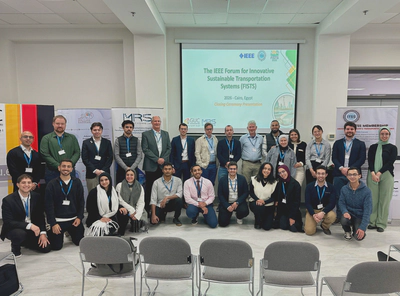
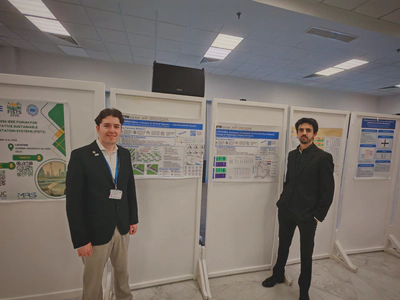
2026 IEEE Forum for Innovative Sustainable Transportation Systems (FISTS 2026), Cairo, Egypt, February 04-06, 2026
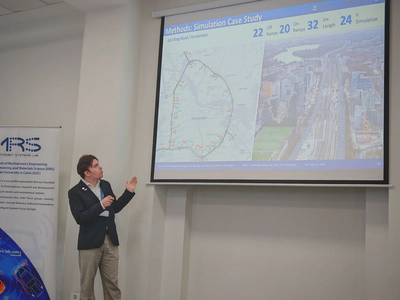
Ramp metering is a widely deployed traffic management strategy that improves freeway efficiency without costly infrastructure expansion. However, conventional ramp metering controllers often prioritise aggregate performance at the expense of fairness, leading to highly uneven waiting times across on-ramps. Such disparities can reduce user compliance, trigger public opposition, and ultimately undermine the long-term sustainability of traffic control systems. This paper proposes C-EQ-ALINEA, a distributed and equity-aware extension of the classical ALINEA ramp metering controller. The approach introduces lightweight information exchange among neighbouring ramps, enabling decentralised coordination that balances congestion impacts without centralised optimisation, detailed traffic models, or additional infrastructure. By preserving the simplicity and robustness of local feedback control, C-EQ-ALINEA offers a directly applicable upgrade path for existing ramp metering installations. The proposed controller is evaluated using calibrated microsimulation of the Amsterdam A10 ring road under highly congested conditions. Results show that C-EQ-ALINEA achieves substantial reductions in total delay and improvements in average speed while maintaining throughput comparable to established coordinated methods. Importantly, the approach delivers a more equitable distribution of delays across ramps under multiple fairness notions, including Harsanyian, Egalitarian, Rawlsian, and Aristotelian perspectives. By improving fairness without sacrificing efficiency or deployability, C-EQ-ALINEA contributes to the sustainable and socially acceptable operation of intelligent freeway traffic management systems.
 |  |  |  |  | |
 |  |  |  |  | |
 |  |  |  |  | |
 |  |  |  |  | |
 |  |  |  |  |  |

Kevin Riehl
Doctoral Researcher & Scientist
My name is Kevin Riehl, and I am a cosmopolitan, technology enthusiast and philantrop. I believe, that technology is the key to make the world a better place, and that learning, self-improvement, collaboration and criticial thinking are our duty as gifted minds.